
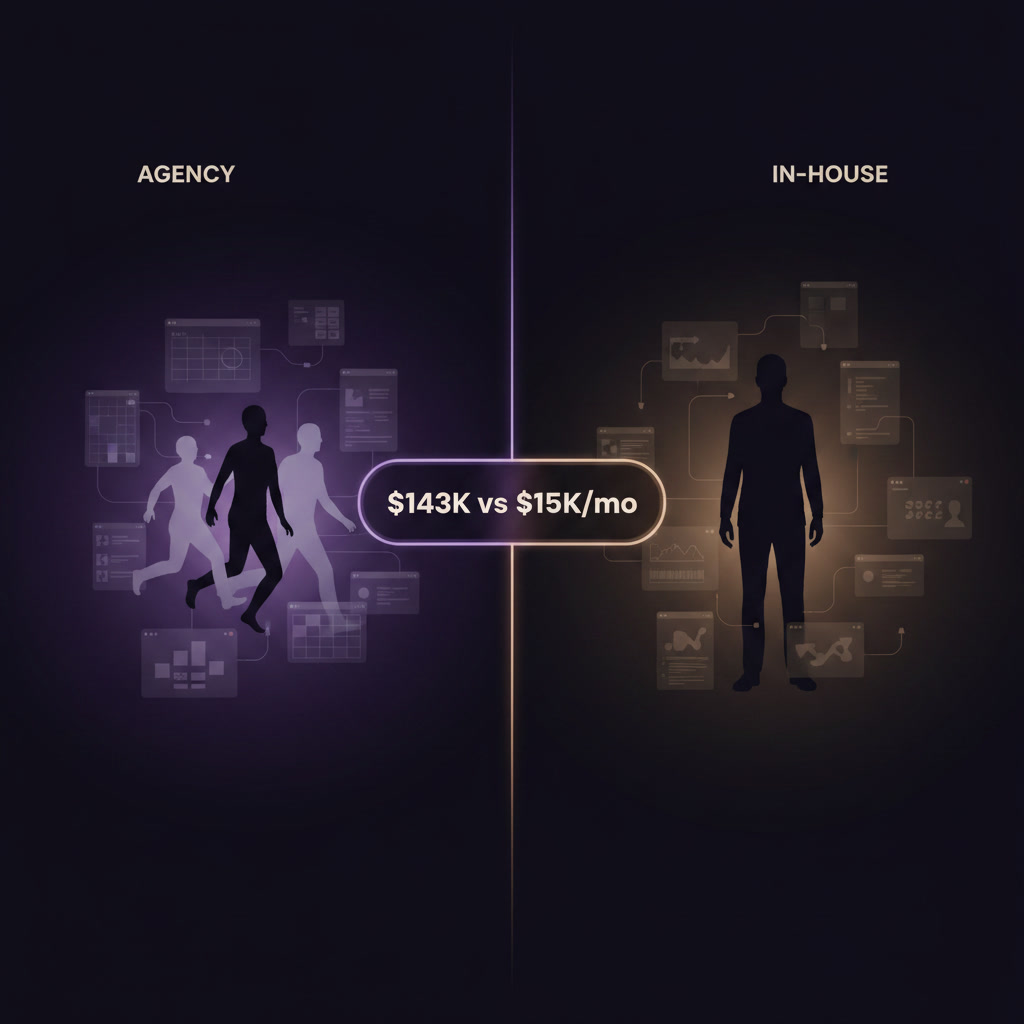
The design agency vs in-house debate is usually framed as a binary choice. It is not. The design agency vs in-house decision comes down to three variables: your current stage, your runway, and the specific design work in front of you right now. What most founders do not calculate: the average Year 1 cost of a mid-level in-house designer is $143,000–$185,000 when you include salary, benefits, recruitment, and the three-month ramp period where output is partial. This article gives you an honest framework — not a sales pitch — for making the right call at your stage.
Table of Contents
- The Real Cost of Hiring In-House
- When a Design Agency Wins
- When In-House Is the Right Call
- The Hybrid Model: Beyond the Design Agency vs In-House Binary
- 10 Questions to Ask Before Hiring a Design Agency
- How Working with D4 Group Works
- Frequently Asked Questions
- Talk to Our Team
The Real Cost: Where the Design Agency vs In-House Math Goes Wrong
Founders typically anchor on base salary when evaluating in-house design hires. That number is roughly half the real cost. In the design agency vs in-house cost comparison, the gap widens significantly once you factor in everything salary does not cover.
Here is the full Year 1 cost breakdown for a mid-level UX/UI designer in North America, according to Glassdoor 2025 compensation data:
| Cost Item | Low | High |
|---|---|---|
| Base salary (mid-level UX/UI) | $85,000 | $105,000 |
| Benefits (health, 401k, PTO — ~25%) | $21,250 | $26,250 |
| Recruitment (agency fee or internal time) | $12,000 | $21,000 |
| Tools (Figma, Maze, Hotjar, etc.) | $4,000 | $7,000 |
| Ramp time (3 months at partial output) | $21,250 | $26,250 |
| Total Year 1 | $143,500 | $185,500 |
That cost covers one designer. One set of skills. One perspective. This is why the design agency vs in-house comparison rarely ends at salary — the full picture looks very different.
The Single-Designer Problem
No mid-level designer is simultaneously senior in UX research, interaction design, visual UI, motion design, and design systems. When you hire one person, you get their specific strengths — and you manage around their gaps.
A startup that needs an MVP designed, a design system built, and ongoing iteration on an existing product needs three different skill profiles. In the design agency vs in-house equation, that is three in-house hires — $430,000–$555,000 per year — or a well-structured agency engagement at a fraction of that cost.
The Dependency Risk
A single in-house designer is also a single point of failure. When they leave — and the average tenure of a startup designer is 18–24 months according to LinkedIn Workforce data — you restart the recruitment and ramp cycle. Every piece of institutional design knowledge walks out with them unless documentation standards are exceptional (they rarely are at pre-Series B).
When a Design Agency Wins
The design agency vs in-house answer shifts toward agency in four clear scenarios.
You Are Pre-Series A and Runway Is Finite
Before product-market fit, speed and flexibility matter more than continuity. An agency engagement can start delivering within a week. An in-house hire takes 6–12 weeks to recruit, 4 weeks to onboard, and 3 months to reach full productivity. That is 5–6 months of runway spent before a single screen ships.
For startups targeting a raise in the next 6–12 months, a design agency delivers investor-grade product work faster and at lower total cost than an in-house hire at the same quality level.
You Need Multiple Design Skills Simultaneously
A pre-launch startup typically needs UX research, wireframing, high-fidelity UI, prototyping, and a design system — in parallel, not sequentially. An agency brings a team. A $15,000/month agency retainer covers senior skills across all five disciplines — equivalent to what three specialized in-house hires would cost at $180,000–$210,000 each per year.
You Have a Specific High-Stakes Project
MVP design. A complete product redesign. A design system build. These are project-shaped problems — they have a clear start, clear deliverables, and a clear end. In the design agency vs in-house framework, hiring in-house for a project creates a retention problem the moment the project is finished. Agencies are built for exactly this shape of work.
You Are Preparing for a Fundraise
Investor-grade product work requires senior design judgment — the kind that comes from having seen 50 products at your stage, not the kind that comes from deep immersion in your single product. Agencies bring cross-portfolio pattern recognition that is genuinely difficult to replicate with a first or second in-house hire.
When In-House Is the Right Call
The honest answer: there are real scenarios where in-house wins. In the design agency vs in-house decision, pretending otherwise would cost you our credibility — and your money.
Post-PMF at Scale
Once you have found product-market fit and are iterating rapidly on a known product direction, the value of deep product immersion outweighs the flexibility of agency engagement. A designer who has lived inside your product for 18 months makes better micro-decisions faster than any external team.
The signal: when you are shipping 3+ features per month and design is on the critical path every sprint, an in-house team is more efficient than managing agency communication cycles. This is where the design agency vs in-house balance tips clearly toward in-house.
Domain Expertise Is Critical
Some products require deep domain knowledge that takes months to develop — medical devices, enterprise fintech, defense-adjacent software. If the design decisions require understanding regulations, workflows, and user contexts that cannot be transferred in a brief, an in-house designer who grows with the domain is the right investment.
Series B+ with Design Culture to Build
At Series B and beyond, design leadership and design culture become strategic assets. A VP of Design who builds and manages an internal team creates organizational capability that compounds over years. At this stage, the design agency vs in-house calculus shifts — you are not just buying design output, you are building design as a core competency.
The Hybrid Model: Beyond the Design Agency vs In-House Binary
Most Series A founders discover that the design agency vs in-house question has a third answer. The most efficient model is not a binary choice — it is a deliberate split:
| Work Type | Best Handled By | Why |
|---|---|---|
| New feature design, MVP work, design system | Agency | Project-shaped, needs broad skill set |
| Daily iteration, sprint-to-sprint UI updates | In-house | Needs product immersion and low communication overhead |
| User research, usability testing | Agency or specialist | Requires methodological expertise most in-house designers lack |
| Design system maintenance | In-house (after build) | Ongoing, low-complexity, needs product context |
In practice: one strong mid-level in-house designer handles daily product iteration. An agency relationship handles strategic design work. This hybrid typically costs 30–40% less than fully in-house coverage of the same scope — while delivering higher quality on the strategic work that investors and users see first. For most Series A companies, this hybrid resolves the design agency vs in-house question entirely.
10 Questions to Ask Before Hiring a Design Agency
Before settling the design agency vs in-house question in favor of an agency, these questions separate the ones worth working with from the ones that will offshore your brief to a junior team and hand you back something generic in four weeks.
- Who will actually work on our project day-to-day — and what is their seniority level? Ask to meet them before signing.
- What does your design process look like from brief to handoff? If they cannot describe it in specific steps, they do not have one.
- How do you handle revisions — and is there a limit? Understand this before work begins, not after.
- What does your developer handoff include? Annotated Figma? Design tokens? Loom walkthrough? The answer tells you whether they have actually shipped products.
- Do you have experience in our industry or product type? Not essential — but relevant patterns from adjacent work are genuinely valuable.
- How many clients are you running simultaneously? More than 4–6 active projects per senior designer is a quality signal to probe.
- Who owns the files and assets when the engagement ends? The answer should be: you do. Always.
- What does success look like — and how do you measure it? Agencies that answer only in deliverables rather than outcomes are optimizing for the wrong thing.
- What does the first two weeks look like — specifically? Discovery, research, alignment, or straight into Figma? The first two weeks reveal the actual process.
- Can we speak to two recent clients at a similar stage to ours? Any agency worth hiring will say yes without hesitation.
How Working with D4 Group Works
We are a design and development agency with 15 years of experience and 500+ projects delivered. Here is what working with us actually looks like — no marketing language.
How an Engagement Starts
Every project begins with a discovery call — 30 minutes, no pitch, no proposal. We want to understand your product, your stage, and the specific problem in front of you. If we are not the right fit, we will tell you directly and, where we can, point you toward someone who is.
If there is alignment, we scope a proposal within 48 hours. Scope includes deliverables, timeline, milestone structure, and what we need from your team to hit the timeline. No vague retainers, no open-ended engagements without clear checkpoints.
Who Works on Your Project
Each project has a dedicated lead designer — senior level — with supporting specialists pulled in as needed (UX research, motion, design systems, development). You will meet the lead designer before the contract is signed. They are your primary point of contact throughout the engagement.
Communication and Transparency
Weekly async updates via Loom — a 5-minute walkthrough of what was done, what is next, and any decisions that need your input. Slack or equivalent for day-to-day questions. No status meetings that could be a Loom.
Files, Assets, and Ownership
Everything we build belongs to you. Figma files, design tokens, component libraries, research documents, recorded walkthroughs. On the last day of a project, you receive a structured handoff package and retain full access to every file produced — whether you continue working with us or not.
What We Work On
UI/UX design, mobile applications, MVP prototypes, design systems, WordPress development, and e-commerce. Browse our case studies to see how this process looks across different industries and product stages.
Frequently Asked Questions
How much does a design agency charge per month?
Design agency retainers for startup-stage product work typically range from $8,000 to $25,000 per month depending on scope and team composition. Project-based engagements typically run $15,000–$45,000 for a defined scope and timeline. In the design agency vs in-house cost comparison, the relevant figure is not against a single salary — it is against the fully-loaded cost of the team you would need in-house to cover the same scope.
When should a startup hire an in-house designer?
The clearest signal is when you are shipping more than 3 features per month and design is on the critical path every sprint. Before that point, the communication overhead and ramp time of an in-house hire typically outweigh the continuity benefit. Most startups are ready for a first in-house design hire at Series A — after product-market fit is established and the design direction is stable. Before Series A, the design agency vs in-house math almost always favors the agency.
Is outsourcing UX design risky?
The risks are real and worth naming: knowledge transfer gaps, communication overhead, and quality variance across agencies. The mitigations are straightforward: meet the actual team before signing, require structured documentation and handoffs, and start with a bounded project before committing to a long-term retainer. The risk of outsourcing to the wrong agency is lower than the risk of hiring the wrong in-house designer — the latter is 6–12 months and $150,000+ to course-correct.
Can a design agency understand our product as well as an in-house designer?
For the first 3–6 months of an in-house hire: yes, comparably. After 12+ months of deep product immersion, an in-house designer develops contextual knowledge that is genuinely hard to replicate externally. This is why the hybrid model — the practical resolution of the design agency vs in-house question — captures the benefits of both without the full cost of either.
What is a typical design agency engagement timeline?
MVP design sprint: 3 weeks. Design system build: 3–5 weeks. Full product redesign: 6–10 weeks. Ongoing retainer: month-to-month with 30-day notice. Most project-based engagements have a defined end state and handoff package — the engagement concludes when the deliverables are complete and your team can carry the work forward independently.
How do we evaluate whether an agency delivered good work?
Three signals: (1) users can complete the primary task without instruction — test this with 5 people before sign-off; (2) your engineering team can build from the handoff file without constant design clarifications; (3) the strategic decisions in the design reflect insight about your users, not just aesthetic preferences. Good agency work should be explainable — every design decision traceable to a research finding or a validated assumption.
Talk to Our Team — No Pitch, Just a Conversation
If you are still working through the design agency vs in-house decision right now, we are happy to give you an honest assessment — including telling you if in-house is the better call for your situation.
30 minutes. No slides. No proposal unless you ask for one. We will look at your current product, understand your stage and runway, and tell you what we would do if we were in your position.